Pour-Over Coffee for Fika: A Repeatable 500-Gram Brew
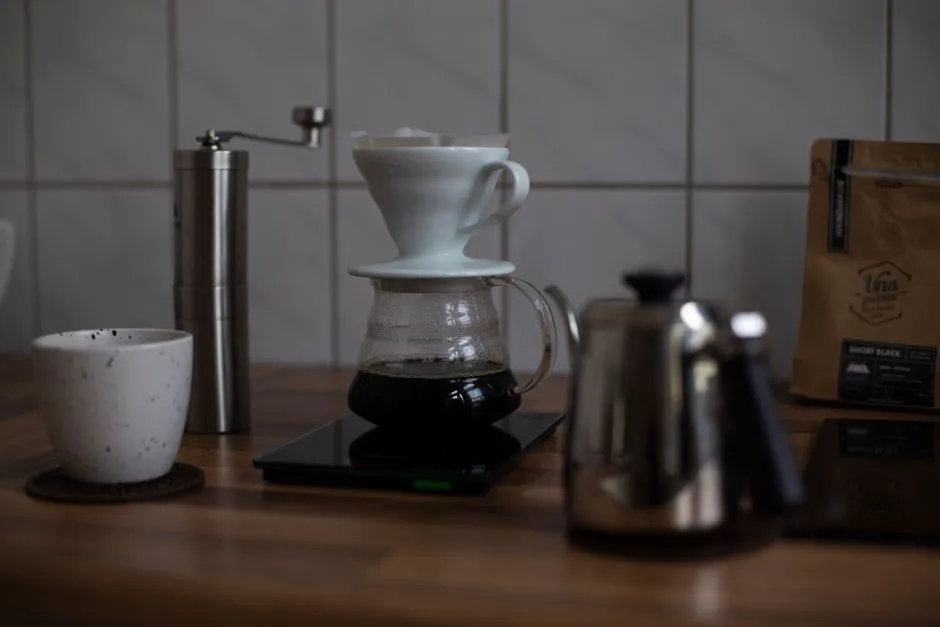
- Start with 30 grams coffee and 500 grams water
- Recipe at a glance
- Equipment
- Heat and rinse
- Grind and level the bed
- Bloom with 60 grams for 40 seconds
- Add 440 grams in controlled pulses
- Swirl, serve, and let it cool enough to taste
- Adjust grind before rebuilding everything
- Scale with the 60-gram-per-litre formula
- Hold briefly, not indefinitely
Start with 30 grams coffee and 500 grams water
For a repeatable pour-over, use 30 grams coffee and 500 grams brewing water. The water-to-coffee ratio is 500 ÷ 30 = 16.67, written as 1:16.7; the equivalent dose is 60 grams coffee per litre. Start with a medium grind and water around 200°F (93°C). Pour 60 grams to wet the grounds, wait 40 seconds, then add the remaining 440 grams in controlled pulses.
Aim for a total brew time near 3:00 to 4:00, measured from the first water. Time is a diagnostic range, not a taste verdict. The coffee, grinder, brewer, filter, water, and pouring pattern all vote.
Recipe at a glance
- Coffee: 30 g
- Brewing water: 500 g
- Ratio: 1:16.7
- Water temperature: start around 200°F (93°C)
- Bloom: 60 g water for 40 seconds
- Remaining water: 500 − 60 = 440 g
- Target total time: about 3:00 to 4:00
This makes less than 500 grams of beverage because grounds and filter retain water. Retention varies, so weigh the carafe if served yield matters rather than promising four mysteriously identical cups.
The Specialty Coffee Association discusses 60 grams per litre as a common filter-coffee brewing ratio, while its home-brewer certification documents begin testing at 55 grams per litre and adjust other variables. That is useful context: ratios are controlled starting points, not proof that one cup must taste right to everyone.
Equipment
- Pour-over brewer compatible with its filter
- Fresh filter paper or approved reusable filter
- Stable carafe with enough capacity
- Digital scale readable to 1 g
- Burr grinder if available
- Kettle with controlled pouring
- Timer
- 30 g coffee
- At least 550 g potable water for brewing and rinsing
Follow the brewer, kettle, grinder, and filter manufacturers’ instructions. Place the brewer and carafe on a stable, heat-resistant surface away from the counter edge. Steam and hot water burn; a graceful circular pour is not worth reaching across a child or pet.
Heat and rinse
Heat potable water to around 200°F (93°C). If your kettle boils and does not display temperature, let it settle briefly, but measure if repeatability matters. Boiling point changes with elevation, and “wait exactly 30 seconds” is not universal temperature control.
Place the filter in the brewer and rinse it with hot water if the filter maker recommends this. Rinsing can remove loose paper flavour and warm the brewer and carafe. Discard the rinse water completely.
Use caution holding the brewer; its walls and carafe may be hot. Check that the assembly is seated securely before adding grounds.
Grind and level the bed
Grind 30 grams coffee to a medium texture suited to the brewer. “Medium” is relative to each grinder, so record the setting. Add grounds and gently shake the brewer to create a level bed.
Do not change dose, grind, water temperature, ratio, and pour structure together. That makes a different cup but teaches nothing about which change mattered.
If coffee is pre-ground, keep the dose and water fixed, then use pour rate and temperature as the practical adjustments available. Store coffee according to the roaster or package guidance in a closed container away from heat, moisture, and strong odours.
Bloom with 60 grams for 40 seconds
Start the timer and pour 60 grams water evenly over the grounds. Sixty grams is twice the coffee dose: 30 × 2 = 60. Make sure no obvious dry pockets remain, but avoid aggressive stirring unless your brewer recipe calls for it.
Wait until the timer reaches 0:40. Fresh roasted coffee often releases visible gas during this stage; the amount varies with coffee and age. A quiet bloom is not evidence that the beans have failed a character test.
Add 440 grams in controlled pulses
Use three pours after the bloom:
- Pour to a total scale reading of 220 g.
- When the water level falls but the bed remains covered, pour to 360 g.
- Finish at 500 g.
The post-bloom additions are 160 g, 140 g, and 140 g. Their sum is 160 + 140 + 140 = 440 g; with the 60-gram bloom, total water is 500 g.
Pour in a controlled spiral over the coffee bed without washing large amounts of grounds high onto the filter wall. Keep the stream steady and the brewer safely below its maximum capacity. If the water rises too high, pause rather than overflow the filter.
Let the bed drain. Stop the timer when dripping becomes intermittent and the brewer is safe to remove, commonly around 3:00 to 4:00 for this starting formula.
Swirl, serve, and let it cool enough to taste
Remove the brewer to a stable dish. Gently swirl the carafe to mix stronger early liquid with weaker later liquid. Pour into prewarmed cups if desired.
Coffee can be dangerously hot. Let it cool to a comfortable drinking temperature and warn guests. Flavour perception changes as temperature falls; evaluate the cup over several minutes before changing the recipe.
For a fika table, 500 grams brewing water may serve two generous mugs or several smaller cups, but final beverage yield and cup size vary. Measure your actual serving vessels.
Adjust grind before rebuilding everything
Fast and sour or thin
If the brew finishes early and tastes sharply sour or weak, grind slightly finer next time. Keep dose, water, temperature, and pours constant.
Slow and bitter or drying
If drawdown runs long and the cup tastes bitter, hollow, or drying, grind slightly coarser. Check that fine particles are not clogging the filter and that pouring is not excessively agitating the bed.
Fast but bitter
Time alone does not diagnose flavour. The coffee may be darkly roasted, water may be very hot for it, or channelled extraction may produce both weak and harsh sensations. Try a modestly cooler temperature or a more even pour, changing one item.
Good time, disappointing cup
The target range is not a guarantee. Adjust by taste. A 3:25 brew can be dull; a 4:10 brew can be lovely with another coffee and brewer.
Scale with the 60-gram-per-litre formula
For 250 grams water, coffee at 60 g/L is 250 × 60 ÷ 1,000 = 15 grams. For 750 grams water, it is 750 × 60 ÷ 1,000 = 45 grams. For 1,000 grams water, use 60 grams.
Scaling changes bed depth and flow. Stay within the brewer and carafe capacity and expect grind to need adjustment. Two separate 500-gram brews may be more predictable than overfilling a small cone while guests watch a coffee landslide.
Hold briefly, not indefinitely
Serve close to brewing. For a group, transfer to a clean preheated thermal carafe designed for hot beverages. Avoid leaving coffee on an active hot plate for a long period; continued heat changes flavour.
Clean equipment according to manufacturer instructions, including any removable valve or seal. Coffee oils and mineral scale accumulate differently and need approved methods. Never mix cleaning chemicals, ventilate as directed, and rinse food-contact parts thoroughly.
Pair the brew with cardamom cinnamon buns or kladdkaka. The home fika guide keeps service simple: coffee should support the pause, not require the host to perform a solo kettle recital for an hour.