Swedish Cinnamon Buns With Cardamom by Weight
- Build cardamom dough around a measured filling
- Recipe at a glance
- Ingredients
- Keep raw flour out of the tasting programme
- Mix without burying the dough
- Let the first rise show itself
- Roll, fill, and shape 12 pieces
- Proof until puffy, not fragile
- Bake by colour, set, and centre temperature
- Troubleshoot one variable at a time
- Scale without losing the formula
- Store for quality and safety
Build cardamom dough around a measured filling
For 12 Swedish-style cinnamon buns, make dough with 500 grams flour, 250 grams milk, 75 grams butter, 60 grams sugar, 7 grams instant yeast, 7 grams salt, and 4 grams ground cardamom. Fill with 75 grams soft butter, 60 grams brown sugar, and 8 grams cinnamon. After two rises, bake at 400°F (204°C) for 14 to 18 minutes, until browned, set inside, and at least 190°F (87.8°C) in a centre bun.
Visit Sweden’s kanelbullar recipe documents the familiar combination of wheat dough, cardamom, butter, sugar, and cinnamon. Swedish bakeries and households use many formulas and shapes; this independent version is scaled for one home tray and makes no claim to be the national final word. Twelve buns would be a peculiar size for a nation.
Recipe at a glance
- Yield: 12 buns
- Active preparation: 35 minutes
- First rise: 60 to 90 minutes
- Shape and second rise: 45 to 70 minutes total
- Bake: 14 to 18 minutes
- Cooling before serving: 20 minutes
- Total: 174 to 233 minutes
The short total is 35 + 60 + 45 + 14 + 20 = 174 minutes. The long total is 35 + 90 + 70 + 18 + 20 = 233 minutes. Rising responds to yeast, dough temperature, room temperature, and shaping; use visible expansion rather than forcing dough to obey a meeting calendar.
Ingredients
Dough
- 500 g all-purpose or bread flour, plus minimal dusting flour
- 250 g pasteurised whole milk
- 75 g unsalted butter, soft but not melted
- 60 g sugar
- 7 g instant yeast
- 7 g fine salt
- 4 g ground cardamom
Filling and finish
- 75 g unsalted butter, soft
- 60 g brown or white sugar
- 8 g ground cinnamon
- 1 g fine salt
- 20 g pasteurised milk for brushing
- 20 g pearl sugar, optional
The dough begins with 250 grams milk for 500 grams flour, a 50 percent milk-to-flour ratio by weight. Butter and sugar make the dough richer and softer; avoid adding flour until kneading has had time to develop structure.
Keep raw flour out of the tasting programme
FDA raw-flour guidance states that most flour is raw and should not be eaten in uncooked dough or batter. Keep flour away from ready-to-eat food, wash hands and tools after handling dough, and bake completely. The filling is delicious; the raw dough is not a preview sample.
Use pasteurised milk and keep it refrigerated at 40°F (4.4°C) or below until needed. If the milk is heated to soften butter or encourage yeast, keep it merely lukewarm; high heat can damage yeast.
Mix without burying the dough
Combine flour, sugar, instant yeast, and cardamom. Add milk and mix until no dry flour remains. Rest 10 minutes, then knead in salt and soft butter a little at a time.
Knead by machine on low to medium speed for about 8 to 10 minutes, or by hand until the dough becomes smoother, elastic, and able to stretch thinly without immediately tearing. Stop to scrape the bowl and check temperature; friction can warm a small dough quickly.
If the dough sticks lightly, use a bench scraper and continue. Add dusting flour only a few grams at a time. A stiff, flour-heavy dough produces buns whose main cultural contribution is requiring more coffee.
Let the first rise show itself
Shape the dough into a ball and place it in a clean lightly buttered bowl. Cover and let rise until roughly doubled and visibly aerated, 60 to 90 minutes in many moderate rooms.
Mark the starting height on a straight-sided container if judging volume is difficult. A warm room may shorten the rise; a cool room may lengthen it. Do not put dough against an uncontrolled heater.
While it rises, combine 60 grams sugar, 8 grams cinnamon, and 1 gram salt. Keep the 75 grams filling butter soft enough to spread without melting.
Roll, fill, and shape 12 pieces
Turn the dough onto a lightly floured surface and press out large gas pockets. Roll to a rectangle about 40 by 30 centimetres, adjusting the shape rather than pursuing the dimensions with legal intensity.
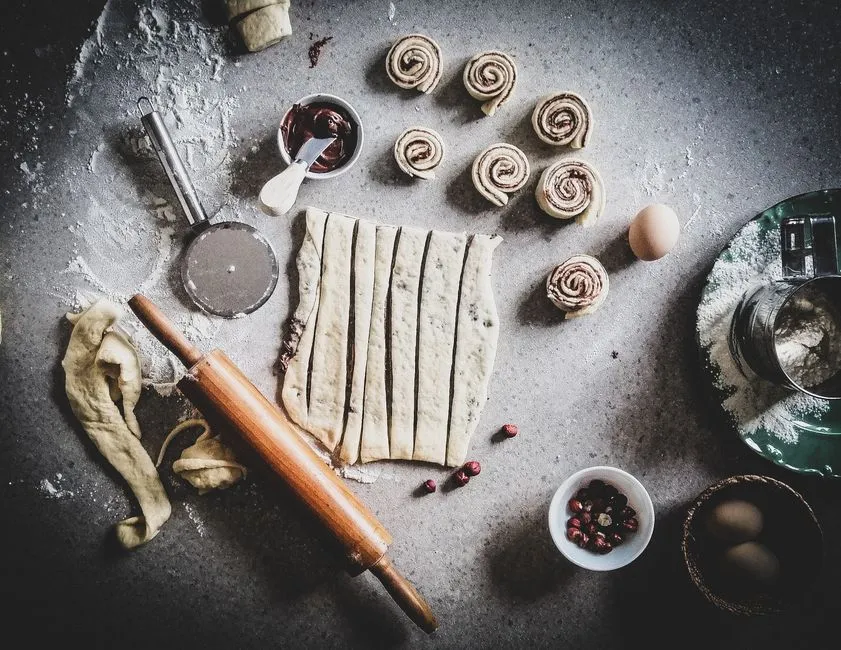
Spread 75 grams butter evenly, leaving a 1-centimetre clean strip along one long edge. Scatter the cinnamon sugar over the butter. Fold the dough in half lengthwise so the filled rectangle becomes about 40 by 15 centimetres.
Cut 12 strips. Twelve equal pieces from a 40-centimetre edge average 40 ÷ 12 = 3.33 centimetres each. A ruler helps; perfection is unnecessary.
For a simple twist, gently lengthen one strip, twist it several times, then coil it around two fingers and tuck the end beneath. Alternatively, roll the original rectangle into one log and cut 12 spirals. Both shapes carry the same measured dough and filling.
Place the buns on a parchment-lined sheet pan with space between them. If the tray is small, use two trays rather than building one cinnamon apartment block.
Proof until puffy, not fragile
Cover loosely and let the buns rise until visibly puffy and a gentle fingertip press returns slowly, often 35 to 55 minutes. Begin heating the oven to 400°F (204°C) before the proof finishes.
The 45-to-70-minute shape-and-second-rise stage includes about 10 to 15 minutes of shaping plus 35 to 55 minutes proofing. If your shaping takes longer, record it honestly; the dough will not object to your spreadsheet.
Brush lightly with 20 grams milk and scatter optional pearl sugar. Avoid flooding the cut layers, which can carry filling onto the pan.
Bake by colour, set, and centre temperature
Bake one tray at a time in the middle of the oven for 14 to 18 minutes. Rotate once if your oven browns unevenly. The tops should be deeply golden, the sides set, and the layered centres no longer raw or gummy.
Check a centre bun with a clean instant-read thermometer, aiming for at least 190°F (87.8°C) as a practical bread-doneness cue. Avoid touching the hot pan or probing only melted filling. If the centre is below the cue or visibly raw, bake longer and recheck.
Move buns to a rack after several minutes so the bottoms do not steam. Cool at least 20 minutes before serving. That waiting period is an excellent moment to brew the 500-gram pour-over.
Troubleshoot one variable at a time
Dense buns
The dough may have been too dry, insufficiently kneaded, under-proofed, or made with inactive yeast. Confirm yeast date and type, weigh flour, and judge both rises by volume.
Filling on the tray
Some leakage is normal. Melted butter, too much filling near the edge, or a loose shape increases it. Use soft butter and tuck ends securely.
Dry crumb
Too much flour or baking beyond set can dry the crumb. Check actual oven temperature and begin testing at 14 minutes.
Pale tops with cooked centres
The oven may run cool or the milk wash may be too light. Verify oven temperature rather than extending baking until the crumb dries.
Scale without losing the formula
For 6 buns, halve every ingredient: 250 grams flour, 125 grams milk, 37.5 grams dough butter, 30 grams sugar, 3.5 grams yeast, 3.5 grams salt, and 2 grams cardamom. Use 37.5 grams filling butter, 30 grams sugar, and 4 grams cinnamon.
For 24 buns, double the ingredients and divide the dough across trays. A doubled batch may need longer mixing and rising because bowl depth and dough temperature change; baking two trays may also alter airflow.
Store for quality and safety
Cool plain buns completely and seal them. They are best fresh; freeze extras promptly in portions and thaw covered. Room-temperature quality storage is appropriate for plain fully baked buns for a short period, but any perishable cream, custard, or dairy-rich topping changes the rule.
Refrigerate perishable toppings and filled buns within 2 hours, or 1 hour above 90°F (32.2°C), and follow the ingredient’s safe window. Never rely on cinnamon to preserve a dairy filling.
Serve these as one option at a simple home fika or pair small portions with kladdkaka when a table needs two textures. The point is a generous pause, not a pastry endurance trial.